 |
Avenue des Champs-Élysées, Paris | |
|
The world's most famous
strolling, shopping and café-sitting boulevard
was once a swamp....
|
||
|
|
|
It's difficult to imagine Paris's most famous and elegant boulevard, the Avenue des Champs-Élysées (map), as marsh and meadowland, but so it was in the early 1600s before the first road was laid out northwest from the Tuileries. Trees were planted along the main meadow in this district, earning the quiet, cool, serene area the name "Elysian Fields" (Champs-Élysées) in 1667. A century later the road was extended, but by 1800 this was still a wildish forest with only a few houses. British, Prussian and Russian soldiers camped beneath its trees after Napoleon's defeat at Waterloo (1812).
With the invention of gas lighting, the Avenue des Champs-Élysées was transformed: fountains and footpaths made it a favorite place to go, see and be seen, whether on foot, on horseback, or in a horse-drawn carriage.
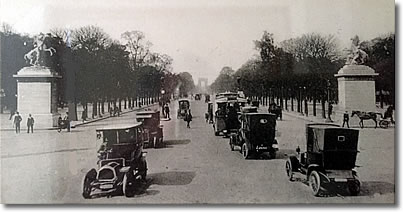
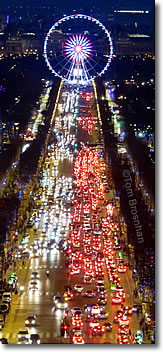
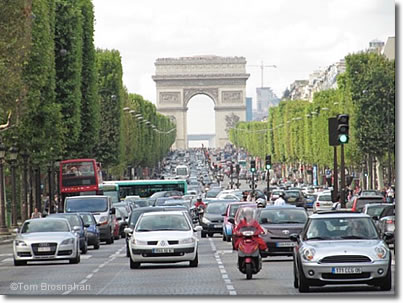
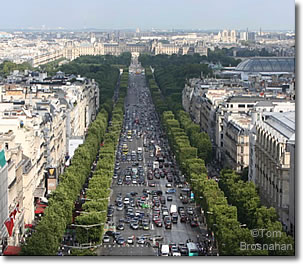
By the mid-1800s the first cafés-dansants had been opened, restaurants followed, then grand Second Empire houses and shops. Finally came the or horseless carriage, and the avenue's present function as a major motor vehicle route was realized—for good or ill. Bordering the Champs-Élysées are upscale residential neighborhoods, embassies and other worthy institutions of low interest to visitors. You must see the Avenue des Champs-Élysées, but perhaps not all of it at once, as it is nearly 4 km (2.5 miles) long from Place de la Concorde, near the Musée du Louvre and Jardin des Tuileries, northwest to Place Charles de Gaulle-Étoile, with the huge Arc de Triomphe (map). As you can see from the photo, the Champs-Élysées is busy with traffic. What you can't see is that the sidewalks are equally crowded. Most days, the avenue is a throng-scene of Parisian life in every possible way. Café-sitting along the avenue is an active experience, not a particularly restful or serene one. There's simply too much vehicular and foot traffic. (For a quiet sit-and-sip, seek out one of Paris's marvelous parks or gardens.)
On the other side of the Arc de Triomphe, the Avenue de la Grande Armée continues northwestward all the way to the modern commercial and residential suburb of La Défense, with its gleaming office skyscrapers and its mammoth Grande Arche de La Défense from which there is also a fine panoramic view of Paris. More...
|
|
Paris's Avenue
des Champs-Élysées, from
the Arc de
Triomphe to the Place
de la Concorde and Palais
du Louvre.
|